Cane vs Walker: Which Does Your Parent Need?
Choosing between a cane and a walker comes down to how much support your parent actually needs to stay upright and move safely. A cane offers light stability for someone who is mostly steady, while a walker or rollator provides a wider, more secure base for anyone whose balance or strength has slipped further. This guide walks you through the practical differences so you can pick the right tool the first time.
Choose a cane if your parent has mild, occasional balance issues or one-sided weakness but can bear weight and walk confidently most of the time. Choose a walker or rollator if they feel unsteady on their feet, fatigue quickly, need to take weight off their legs, or have had a fall or near-fall. When in doubt, the walker is the safer default, and many physical therapists recommend it after any fall.
Choose a Cane when…
- Balance issues are mild or come and go rather than being constant
- Weakness or pain is mostly on one side (after a hip or knee issue, for example)
- Your parent can still bear full weight and walk without feeling like they might topple
- They want something lightweight, portable, and easy to use on stairs and in tight spaces
Choose a Walker or Rollator when…
- Balance is noticeably unsteady or your parent has already had a fall or near-fall
- They need to put real weight on the device to stay upright or take pressure off both legs
- Endurance is limited and a built-in seat (rollator) lets them rest on longer walks
- Both arms and hands work well enough to grip, steer, and brake the device
Side-by-Side Comparison
| Factor | Cane | Walker or Rollator |
|---|---|---|
| Cost | $15-$60 for a quality single-point or quad cane | $40-$200+ for a standard walker or rollator with seat and brakes |
| Stability provided | Light support; one or four small contact points | High; a wide four-point frame or wheeled base surrounds and supports the body |
| Weight-bearing | Limited; not meant for heavy leaning | Substantial; designed to offload weight from the legs |
| Best for | Mild balance issues, one-sided weakness, confident walkers | Greater instability, fall history, weak legs, low endurance |
| Portability | Very portable; folds or hangs easily, light to carry | Bulkier; folds but heavier and harder in tight spaces and cars |
| Stairs and tight spaces | Easy on stairs and in narrow doorways | Difficult on stairs; needs wider clearance for doorways and halls |
| Rest while walking | None | Rollators include a padded seat for resting on longer outings |
The equipment that changes the most
Most of what caregiving costs is time. These four are the purchases that reliably buy some of it back, and they are the ones families tell us they wish they had bought sooner.
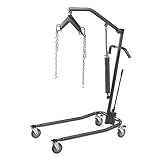 Drive Medical Hydraulic Patient Lift
A full lift is what makes one person able to manage a transfer alone. It is the single purchase that most often delays a move into residential care.
Check price on Amazon →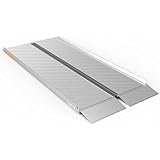 EZ-ACCESS Singlefold Wheelchair Ramp, 6 ft
Folds like a suitcase and carries in a car boot, so the same ramp handles the front step at home and the kerb at an appointment.
Check price on Amazon → Drive Medical Nitro Rollator with Seat
The seat matters more than the wheels. Being able to stop and rest is what decides whether someone still goes out at all.
Check price on Amazon → Vive Stand Assist Rail for Couch or Chair
Getting out of a low sofa is where most falls at home start. This is the cheapest thing on the list and often the first one needed.
Check price on Amazon →As an Amazon Associate we earn from qualifying purchases, at no extra cost to you. Researched guidance, not medical advice. Prices change, so check before buying.
How to tell which one your parent actually needs
Start by watching how your parent moves on a normal day. If they reach for furniture or walls only occasionally, recover their balance easily, and can stand from a chair without much trouble, a cane is usually enough support. The cane is meant to take a small amount of weight and improve balance, not to hold someone up. If, on the other hand, they grab for anything within reach, shuffle, sway, or look like they could fall at any moment, a cane will not be enough and may give a false sense of security. That level of instability calls for the wider, more secure base of a walker or rollator. A simple rule many physical therapists use: a cane improves balance, while a walker provides balance.
When to step up from a cane to a walker
It is common for needs to change, especially after an illness, surgery, or a fall. Move from a cane to a walker if your parent starts leaning heavily on the cane, has a fall or repeated near-falls, becomes winded or wobbly partway through a walk, or is told by a doctor to keep weight off a leg. Trying to push through with a cane when more support is needed is a leading cause of injury. It is far safer to size up to a walker sooner than to wait for a serious fall to force the decision.
Walker vs. rollator: which kind of walker is right?
If you decide on a walker, the next choice is a standard (no-wheel or two-wheel) walker versus a rollator (four wheels, hand brakes, and a seat). A standard walker is the most stable because all four legs stay planted, and it is ideal for someone who needs to lean firmly with each step or is unsteady. A rollator rolls smoothly and lets your parent keep a more natural walking pace, and the built-in seat is a real benefit for anyone who tires easily on longer outings. The tradeoff is that a rollator requires enough hand strength and judgment to use the brakes, and it is less suited to someone who needs to put heavy weight on the frame.
Getting the fit and use right
Whichever device you choose, fit matters as much as the device itself. With arms relaxed at the side, the top of a cane or the handgrips of a walker should sit at wrist-crease height, putting a slight bend in the elbow. A cane is held on the stronger side and moves forward with the weaker leg. A walker should be advanced a short distance, then stepped into, never used to climb stairs. Whenever possible, have a physical therapist confirm the choice and height; many Medicare plans cover a PT evaluation and the device itself when prescribed.
Frequently Asked Questions
After any fall, most physical therapists lean toward a walker rather than a cane. A fall signals that balance and stability are compromised, and a walker's wide base offers far more protection. You can always step back down to a cane later once strength and confidence return, ideally with a therapist's guidance.
Yes. Both canes and walkers are considered durable medical equipment under Medicare Part B when your doctor prescribes them as medically necessary. Medicare typically pays 80% after the Part B deductible, leaving you responsible for the remaining 20% when you use a Medicare-enrolled supplier.
A single-point cane has one tip and is lighter and easier to maneuver, suiting people who need only light balance support. A quad cane has four small feet at the base for a wider, more stable footing and can stand on its own, making it a good middle step for someone who needs more support than a standard cane but is not ready for a walker.
Sometimes, yes. Some people use a cane for short, familiar trips around the house and a rollator for longer outings or uneven terrain where fatigue and stability are bigger concerns. If their needs vary that much, it is worth a physical therapy evaluation to make sure the cane is still safe for any of their daily activities.
Rollators require the user to remember to lock the hand brakes before sitting on the seat and to steer safely. For a parent with significant memory or judgment problems, a standard four-legged walker with no wheels is often safer because there are no brakes to forget and the frame stays planted with each step.